VPNScore Methodology for Meet Requirements
Meeting Requirements is a pivotal metric within the VPNScore system, assessing how well a VPN service fulfills the specific needs and expectations of its users. This score is derived from VPN user reviews that reflect real-world experiences with the VPN’s features and performance. Our well-developed methodology ensures that the VPNs evaluated under this metric are assessed based on their ability to meet the varying demands of users.
1. Review Collection Process
To ensure a comprehensive analysis, we gather publicly available user reviews globally and regionally for each VPN product. These reviews are specifically filtered to highlight mentions of semantic terms for Meet Requirements” and are filtered to highlight the positive, negative, and neutral sentiments of the user. This approach helps us collect a focused dataset that directly pertains to the user experience regarding a VPN’s ability to Meet Requirements.
2. Analysis and Classification of Reviews
Our scoring algorithm evaluates the following data points to determine VPNScore for each VPN:
- User Satisfaction: Derived from sentiment analysis of user reviews specifically mentioning VPN meeting user needs or user requirements being fulfilled.
- Feature Completeness: Evaluate whether the product offers a comprehensive set of features that fulfill the requirements for its intended use.
3. Key Scoring Components for Meet Requirements
The following components are crucial in our scoring algorithm for Meet Requirements:
- Review Volume & Recency: The quantity of reviews and their timeliness are crucial in assessing how well a VPN meets user requirements. Recent reviews are prioritized to ensure the scores reflect the current capabilities and features of the VPN.
- Sentiment Analysis: We analyze the sentiment behind user feedback to understand the overall satisfaction with how the VPN performs in real-world scenarios, addressing users’ specific needs.
4. Key Scoring Components for Meet Requirement
The following components are crucial in our scoring algorithm for Meet Requirement:
- Normalization Process: Scores for the Meet Requirements metric are normalized on a 0-10 scale to ensure fair and accurate comparisons across different VPN products.
- Review Decay Mechanism: Older reviews are gradually weighted less through our Review Decay Mechanism, ensuring that the Meet Requirements score reflects the most up-to-date and relevant feedback from VPN users.
4. Calculation of VPNScore for Meet Requirements
The ‘Meet Requirements’ score is calculated by normalizing the average score for the factors of User Satisfaction and Feature Completeness. The final score is based on 80% weightage of the average score for User Satisfaction and Feature Completeness while 20% weightage of the number of reviews. This normalization ensures a fair comparison across products, adjusting for variations in review volume and distribution.
| Factor | Description | Weightage |
| User satisfaction | Calculated by normalizing the average score for User Satisfaction of the VPN’s offering and Feature Completeness | 80% |
| Popularity Score | Measure of how popular the VPN is based on user reviews | 20% |
5. VPNScore Grid for Meet Requirements:
The VPNScore Grid for Meet Requirements evaluates how well various VPN services fulfill user needs and expectations. By categorizing VPNs into four quadrants—Emergents, Experts, Challengers, and Leaders—this grid aids users in finding the most reliable VPNs that meet their specific requirements.
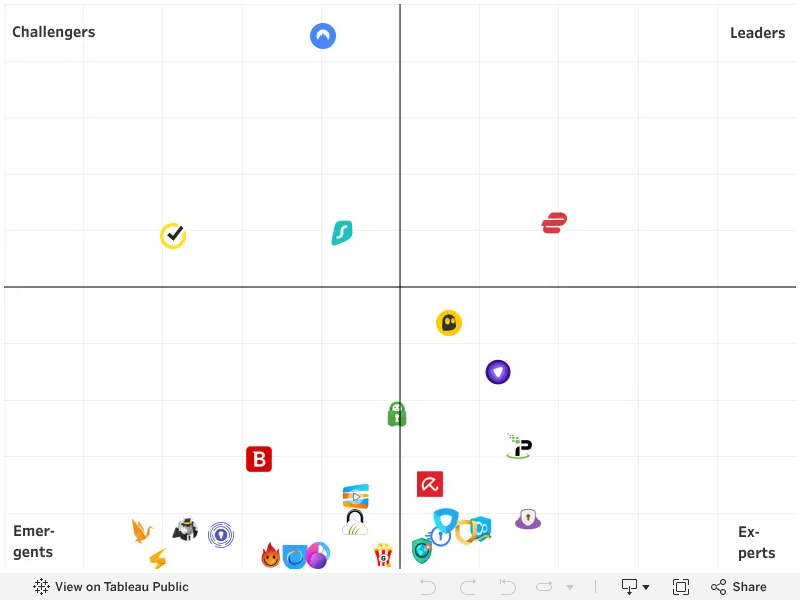
Meet Requirements Grid Interpretation
- Leaders: Products that excel in both in popularity and user satisfaction, establishing them as top performers in meeting user requirements among VPN services.
- Challengers: Products with high popularity but struggling with meeting users requirements indicate the potential that has not yet been fully realized.
- Experts: Products that achieve high user satisfaction with comparatively less popularity, suggesting they offer feature completeness despite less popularity on the internet.
- Emergents: Products with less popularity and lower satisfaction scores are often new or need significant improvements.